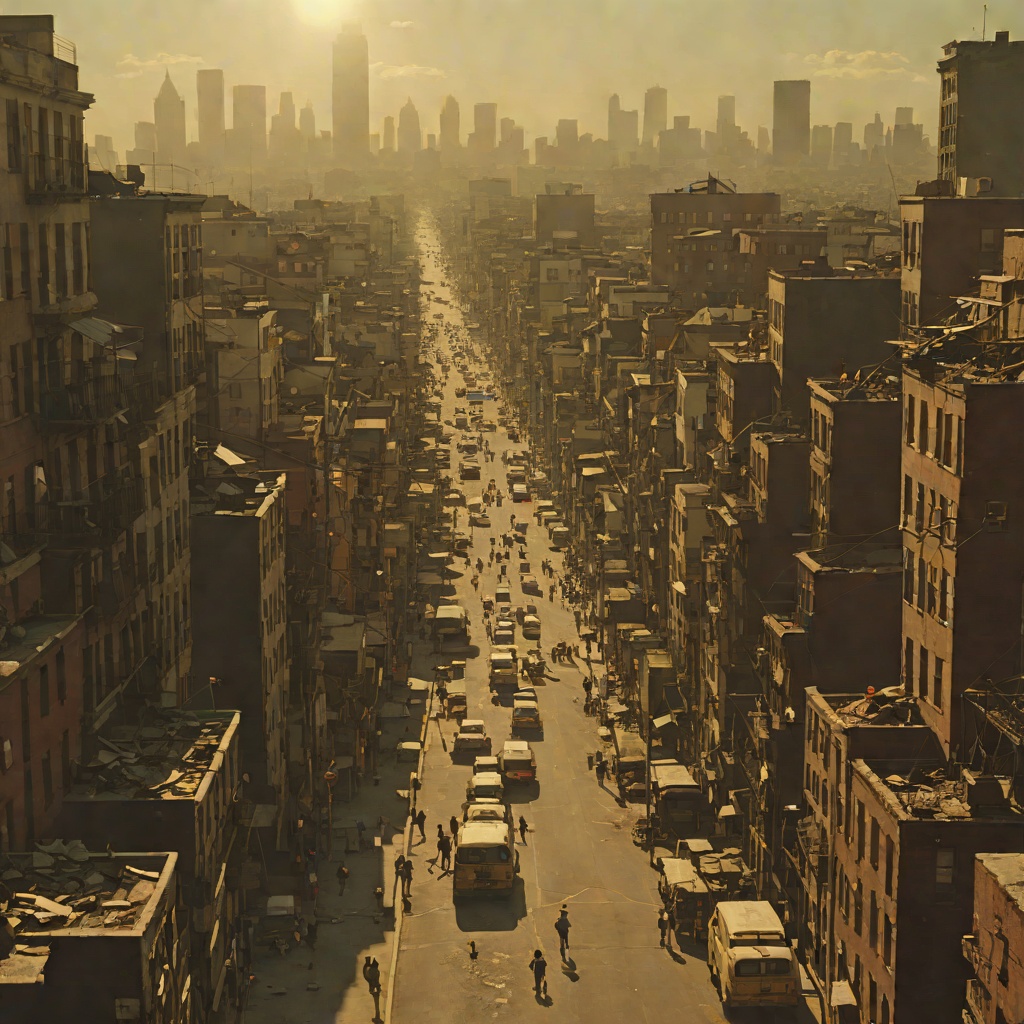
Lower East Side
City of GodThe Lower East Side stands as a cornerstone of New York City's identity, a neighborhood whose very name evokes the dense, layered history of immigration and urban change that defines the metropolis. In City of God, it is presented not merely as a geographic location but as a living testament to the city's enduring nineteenth-century character, a place where the past physically persists amid the relentless churn of modern life. Its significance lies in its dual nature: a repository of the city's foundational architecture and a vibrant, contested space where the complexities of contemporary urban existence play out daily.
A Landscape of Enduring History
The Lower East Side is described as a place where the nineteenth century remains visibly present, maintaining the six-story height of that era even as the city around it supposedly deconstructs and remakes itself every five minutes. This architectural persistence is part of a broader pattern across New York, where the Village, East and West, the Lower East Side, Brooklyn Bridge, Central Park, the row houses in Harlem, and the iron-fronts in Soho all retain their historical character. The neighborhood thus embodies the idea that the city's grid, laid out in the 1840s, means its inhabitants still live with the decisions of the dead, walking streets where generations have trod. This sense of a palimpsest-like city, where the past is never fully erased, gives the Lower East Side a particular weight as a site of memory and continuity.
A Crucible of Contemporary Urban Life
Beyond its historical facade, the Lower East Side is a stage for the city's vibrant and often chaotic present. It is a place where coded ethnic and social enclavists, multiculturally suspicious and verbally aggressive, navigate a dense urban environment. The neighborhood is part of the city's great sputtering experiment in a universalist society, where anyone can be anything and the ID is planetary, a sentiment that finds its most intense expression in the crowded intersections and bustling streets. The area is also a target for external anxieties, as evidenced by the correspondence received by a local reverend from missionaries and from individuals who have taken a Sacred Oath to defend the Republic and the name of Jesus Christ from alien heathen interlopers, even if from the federal government. This juxtaposition of the neighborhood's immigrant history with contemporary fears of the other highlights its ongoing role as a flashpoint for questions of identity and belonging.
A Walk Through Its Streets
The Lower East Side is rendered in vivid, sensory detail through a walk that begins at Union Square Park and moves through the surrounding areas. The scene captures the neighborhood's vibrant commercial life: the farmers' market with its banks of potted flowers and truck farm produce from New Jersey, the brilliant color fields of pears and apples, spinach, kale, and carrots in the sunlight. Along Fourteenth Street, the venue for cheap clothes hanging from pipe racks on the sidewalk, big hand-crayoned sale signs in the windows, and tables with hats and gloves for the coming winter, the neighborhood's bustling, unsentimental exchanges between buyer and seller rehash the first act of civilization. The walk continues past the smells of pizza and sidewalk incense, down Seventh past the double-parked paramedics of St. Vincent's, with distant sirens tolling the truth of eternal emergency, and slanting eastward along Greenwich Avenue past Mexican and Indian restaurants and coffee ritual places. This detailed portrait shows the Lower East Side as a place of intense, immediate sensory experience, where the city's commercial and social energies are on full display.
A Site of Ecological and Social Observation
The Lower East Side, as part of the broader urban fabric, is also a place where the natural and human worlds intersect in ways that invite deep reflection. The city itself is described as a spectacular phenomenon in the unnatural world, a primatial over-soul that secretly depends on the human need to walk among strangers. This ecological perspective extends to the observation of a brown ant population in a patch of dirt under a tree in Central Park, where the narrator hunkers down with children to watch these infinitesimal creatures build an underground city. The ants, each not an eighth of an inch long, are described as purposive, disciplined, and with a stronger work ethic, working for the queen as an egg-laying monarch. This meditation on the ants' invisible organ of aggregate thought, an unlocatable organ of thought beyond the capacity of any one of them to understand, serves as a metaphor for the city itself, a collective brain that emerges from the random and unpredictable movement of great numbers of human beings. The Lower East Side, as a dense and vital part of this urban organism, is thus a microcosm of the city's larger, almost organic, processes of life, work, and social organization.